Wondering where your coffee actually comes from? The main coffee growing regions of the world are South America, South-East Asia, Africa and Central America, with Brazil and Vietnam producing the most.
Knowing the map is a first step in understanding ethical coffee sourcing, because every sourcing claim starts with a place of origin.
| Item | Value |
|---|---|
| World coffee production, 2026/27 forecast | 189.7 million 60-kg bags (record) |
| Brazil, 2026/27 forecast | 71.9 million bags |
| Vietnam, 2026/27 forecast | 32.5 million bags |
| Central America and Mexico, 2026/27 forecast | 17.7 million bags |
| Colombia, 2026/27 forecast | 13.4 million bags |
| Ethiopia, 2026/27 forecast | 12.1 million bags |
These figures come from the USDA Foreign Agricultural Service July 2026 coffee report. They are forecasts and can change, so check the source before you rely on them.
How the main coffee growing regions compare
According to FAO data summarised on Wikipedia’s list of countries by coffee production, world production of green coffee was 11.1 million tonnes in 2023. Brazil led with 30.8% of the total, followed by Vietnam (17.7%) and Indonesia (6.8%).
The same FAO figures split the 2023 harvest by region:
- South America: 41% of the world’s coffee
- South-East Asia: 27%
- Africa: 17%
- Central America: 10%
The FAO recorded 81 countries and territories producing coffee in 2023, as listed on the same Wikipedia page. Only 53 of them produced more than 1,000 tonnes, so a handful of origins supply most of what reaches the cup.
Brazil: the largest producer and its two-year rhythm
The USDA’s July 2026 report forecasts Brazil’s combined harvest at a record 71.9 million bags in 2026/27. Brazil accounts for nearly 40 percent of world production, so its weather shapes global supply and prices.
Most of the crop is Arabica, forecast at 47.5 million bags, against 24.4 million bags of Robusta, according to the same USDA report. Over 70 percent of Brazil’s Arabica is grown in Minas Gerais, while approximately 70 percent of its Robusta is grown in Espirito Santo.
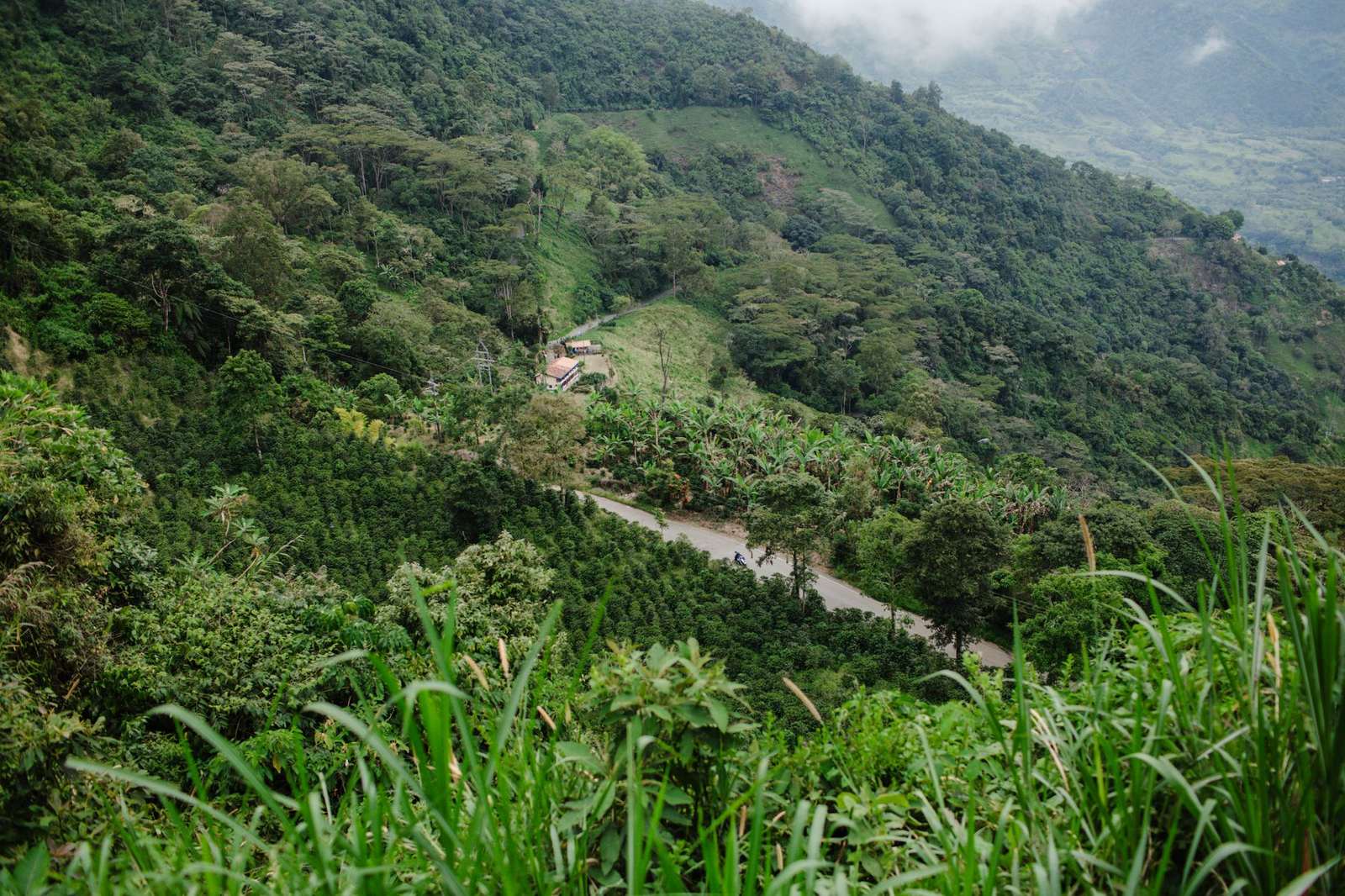
Arabica trees naturally alternate between high-yielding on-years and lower-yielding off-years, a biennial cycle the USDA July 2026 report describes as especially clear in Brazil. Under normal conditions the on-year crop can rise 5 to 10 million bags and fall by a similar amount the next year.
Weather can break the pattern. In the same report, drought and high temperatures in 2021/22 reduced off-year output by 13.3 million bags.
Colombia and the rest of South America
The USDA’s July 2026 forecast has Colombian output rising 900,000 bags to 13.4 million in 2026/27. Exports, mostly to the United States and European Union, are forecast at 12.2 million bags.
Colombia’s yield is sensitive to rain. The same report lowered its 2025/26 estimate by 1.3 million bags to 12.5 million because of excessive rain and cloud cover, and it raised Peru’s 2025/26 estimate to 4.8 million bags on higher yields.
A USDA report from June 2019 described a Colombian renovation programme, mostly using rust-resistant varieties. It raised yields nearly one-third to 18.2 bags per hectare and lowered the average age of coffee trees to 7 years (from 15).
Vietnam and Indonesia: South-East Asia
Vietnam is forecast to produce a record 32.5 million bags in 2026/27, on expanding area and higher yields, per the USDA July 2026 report. Most of it is Robusta.
The USDA’s June 2019 report put Robusta at over 95 percent of Vietnam’s output. It explained that Arabica trees produce good cherries only when grown at least 1,000 meters above sea level, which limits expansion because of remote locations and logistics.
The July 2026 forecast for Indonesia is 11.4 million bags, down 1.0 million. Robusta is expected at 10.0 million bags and Arabica flat at 1.4 million; excessive rainfall disrupted flowering in Southern Sumatra and Java, where approximately 75 percent of the crop is grown.
Ethiopia, Uganda and Africa
Ethiopia is forecast to reach a record 12.1 million bags in 2026/27 on higher area and yield, according to the USDA July 2026 report. Its bean exports are forecast at 7.1 million bags.
Over the last 4 years, the same USDA report says, growth has been driven by replacement of over half of the cultivated area with higher-yielding varieties.
Africa as a whole supplied 17% of the world’s coffee in 2023, per the FAO-based Wikipedia list.
Central America and Mexico
Production in Central America and Mexico is forecast to rise nearly 600,000 bags to 17.7 million in 2026/27, according to the USDA July 2026 report. Honduras accounts for nearly all of that growth, rebounding 500,000 bags to 6.0 million, and regional exports are forecast at 14.0 million bags.
Disease has shaped the region’s recent history. The June 2019 USDA report refers to the coffee rust outbreak that first lowered output in 2013/14 and said several countries remained below their pre-rust level at that date.
Why the region matters when you read sourcing claims
Production statistics describe countries, not individual farms or lots. If you want to see how origin appears on packaging, learn how to read a coffee bag label, and for one model of buying, see what is direct trade coffee.
Be careful when comparing numbers across sources. Databoks, citing USDA data, notes that harvest years differ by country:
- Indonesia and Peru: April 2024 to March 2025 for the 2024/2025 harvest
- Brazil: July 2024 to June 2025
- Vietnam, Colombia, Ethiopia, Uganda, India, Honduras and Mexico: October 2024 to September 2025
Frequently asked questions
Which country grows the most coffee?
Show answer
Brazil. It produced 30.8% of the world’s green coffee in 2023 per FAO-based data, and the USDA’s July 2026 report forecasts a record 71.9 million bags for 2026/27.
Which regions grow mostly Robusta?
Show answer
Vietnam is the clearest case, with over 95 percent Robusta in the USDA’s June 2019 report. Indonesia is also Robusta-heavy, with 10.0 million of its 11.4 million forecast bags in the July 2026 report.
Why do Brazilian harvests swing from year to year?
Show answer
Arabica trees alternate between high-yielding and lower-yielding years, and weather events can synchronise yields across large areas. The USDA July 2026 report says on-year crops can rise 5 to 10 million bags.
Why do production figures differ between sources?
Show answer
Sources measure different things.