If you’re wondering how much do coffee farmers earn, the short answer is: often too little. In Ethiopia, a 2022 GIZ report put average coffee farmer income at EUR 1,970 a year, under a EUR 2,400 living income benchmark.
Earnings are one part of the wider picture of sustainable coffee, alongside farming practices and traceability.
| Item | Value |
|---|---|
| Living income benchmark, Ethiopian household | EUR 2,400 per year |
| Average income of Ethiopian coffee farmers in the GIZ example | EUR 1,970 per year |
| Income gap in that example | EUR 430 per year |
| Living Income Reference Price, Ethiopian green coffee | EUR 5.20 per kg |
| Earnings of farmers in Aceh, Indonesia, against the reference price in 2020 | 40% of the reference price |
These figures come from a GIZ Ethiopia report of April 2022 and a Daily Coffee News report on Fairtrade’s Indonesia price. They are estimates and can change, so check the sources before you rely on them.
What does a living income mean for coffee farmers?
Farm income is judged against a living income: the income a household in a particular place and time needs to afford a decent standard of living, as GIZ describes it. The approach counts these costs:
- Food and water
- Housing
- Education and healthcare
- Transport and clothing
- A provision for unexpected events
A living wage is a different measure. The Sustainable Coffee Challenge guide defines it as a monthly wage for an individual in contractual employment, while a living income is the annual net household income from all on- and off-farm sources.
That difference matters because coffee farming households are independent businesspeople, not employees, and often earn income in a variety of ways, according to the same guide. So there is no single farmer salary. What a household earns depends on price, yield, land size and costs.
How much do coffee farmers earn in Ethiopia?
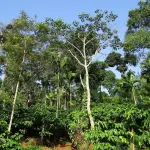
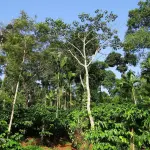
Coffee is Ethiopia’s number one export commodity, and GIZ reports that it is almost exclusively grown on small farms that support about 5 million producers and their families. In the Nono Sale district, coffee grows naturally under the shade of big trees, a system covered in the guide to shade grown coffee benefits.
GIZ’s April 2022 report sets the living income benchmark for an Ethiopian household at EUR 2,400 per year. Even with exceptionally high coffee prices that year, GIZ puts average income at only EUR 1,970 per year, an income gap of EUR 430.
To close that gap, GIZ says buyers would need to pay EUR 5.20 per kilogram of green coffee as the Living Income Reference Price. It adds that for most coffee farmers in the area, coffee income barely covers basic costs.
One farmer interviewed in Nono Sale estimated that coffee contributes more than 60 percent of her income. She also said the higher price that year had no positive effect on her life, given inflation and rising prices for basic goods. GIZ concludes that farm-gate prices must rise relative to everyday costs, not just in absolute terms.
The Aceh reference price in Indonesia
In April 2022, Daily Coffee News reported on a Fairtrade International coffee reference price for Indonesia. The research involved more than 360 farmers from five cooperatives in Aceh, a region of Sumatra.
The same report found that farmers in Aceh earned only 40% of the reference price in 2020. Fairtrade set that price at 13,600 Indonesian rupiah (US$0.95) per kilogram of coffee cherry, 26% higher than local market prices at the time.
Fairtrade estimated that this might translate to about $2.82 FOB, though the report notes that the estimate comes with numerous caveats. Because this price is for cherry and Ethiopia’s is for green coffee, the two figures should not be compared directly.
The report also quotes a Fairtrade advisor on price volatility: farmers can’t be sure that any farm investments made today will pay off in the future, even when market prices are high.
Why coffee farmers earn so little
The Sustainable Coffee Challenge guide says estimated average coffee income falls at or below the poverty line in many countries, and far below the living income benchmark in most. It lists these exacerbating factors:
- Low and volatile coffee prices
- Low productivity and low farm investment
- Small land sizes
- Climate change
Price swings are a long-running problem. Daily Coffee News describes the 2018-2020 price crisis as the latest in a series over the past half-century that trapped millions of farmers in a boom-and-bust cycle of poverty.
Raising yields alone is not a full answer. A Fairtrade adviser quoted by Co-operative News says the impact of productivity increase tends to press the price down. Climate pressure is also on the list above, and the article on climate change and coffee production looks at how it affects the crop.
A broader claim comes from a coffee company. Cafédirect states that around 80% of coffee farmers globally don’t earn enough to afford a decent standard of living. Treat that as a company’s statement rather than an independent measurement.
How reference prices and minimum prices work
Fairtrade defines a Living Income Reference Price as the price a typical farmer household with a viable farm size and a sustainable productivity level needs to earn a living income from its crop. Its reference price page uses four parameters:
- The costs of a decent living, set as a living income benchmark
- A sustainable target yield
- The costs of sustainable production, including a living wage for any hired labour
- A viable crop area that fully uses the household’s available labour
The same page counts 30 reference prices for nine products across 22 countries, starting with cocoa in Ghana and Côte d’Ivoire in 2018. As of Co-operative News in March 2024, coffee prices had been calculated for Colombia, Indonesia, Uganda, Honduras, Ethiopia, Peru and Nicaragua.
These sit alongside the Fairtrade Minimum Price, which acts as a safety net when market prices drop. According to the same March 2024 report, minimum prices are based on a global average cost of production and do not cover a decent living, which is why Fairtrade developed its Living Income Strategy in 2017 around three pillars. Those pillars are responsible procurement, sustainable production and an enabling environment for producers.
A reference price is a benchmark, not a guarantee. GIZ notes that export is no guarantee of high prices or fair shares for farmers, so reliable buyers are needed. In its Ethiopian project, cooperatives were certified to the EU organic standard and a traceability system was set up to make selling to international markets easier.
Buyers are starting to publish targets. Cafédirect’s living income page states a goal to pay at least Living Income Reference Prices for 100% of the coffee it buys directly from cooperatives by 2030, where those prices have been established.
Frequently asked questions
What is the difference between a living income and a living wage?
Show answer
A living wage is a monthly figure for an individual in contractual employment, while a living income is the annual net household income from all sources. The Sustainable Coffee Challenge guide says living wage suits analyses of farmworkers on coffee farms.
Does the Fairtrade Minimum Price guarantee a living income?
Show answer
No. Co-operative News reported in March 2024 that Fairtrade International acknowledges minimum prices and the Premium are not sufficient for realising living incomes.
Do higher coffee prices always raise farmers’ income?
Show answer
Not necessarily. In GIZ’s April 2022 Ethiopia report, a year of exceptionally high prices still left average income EUR 430 below the benchmark, and rising costs for basic goods eroded the benefit.
Is there one global figure for what coffee farmers earn?
Show answer
The sources used here give local estimates rather than a single number. Examples include EUR 1,970 per year for the Ethiopian farmers in the GIZ example and 40% of the reference price for Aceh farmers in 2020.